

 English
 عربى
عربى Español
 Français
Plastic food containers are widely used across daily food packaging scenarios. From preserving boxes to lunch boxes and sealed storage containers, their demand continues to grow due to lightweight, easy handling, and cost control during production. As usage expands, expectations for consistency, appearance, and productivity also rise. This places higher requirements on the Food Container Mould design and manufacturing.
Thin-wall food containers, in particular, bring specific challenges. They require faster filling, stable wall thickness, and short cycle times while maintaining shape after cooling. Any imbalance in mould design may cause deformation, uneven surface, or unstable output rhythm. These issues often become visible only after the mould trial, making early design decisions especially important.
How Food Container Mould Design Supports Thin Wall Structure
Thin-wall containers rely heavily on mould precision. Gate position, runner layout, and cavity balance directly affect how molten plastic flows into the cavity. A well-planned Food Container Mould allows plastic melt to spread evenly without excessive pressure concentration.
Hot runner systems are commonly applied in this type of mould. By reducing flow resistance and maintaining melt temperature, the hot runner helps plastic fill thin areas more smoothly. This approach also supports stable stamping quality and consistent appearance across cavities.
Cycle time for thin-wall containers usually ranges from 20 to 30 seconds. Cooling efficiency becomes a core factor here. Cooling channels must be placed close enough to thin sections without weakening mould strength.
Material Selection for Food Container Mould Performance
The choice of mould steel is closely linked to expected mould life and production rhythm. Different projects may require different steel grades depending on output volume and cycle speed. A Food Container Mould Manufacturer typically recommends steel material based on these practical factors rather than generic standards.
On the product side, PP and PE are commonly used raw materials for food containers. These materials offer good forming ability and are suitable for mass production. Their flow characteristics also influence gate design and runner balance inside the mould.
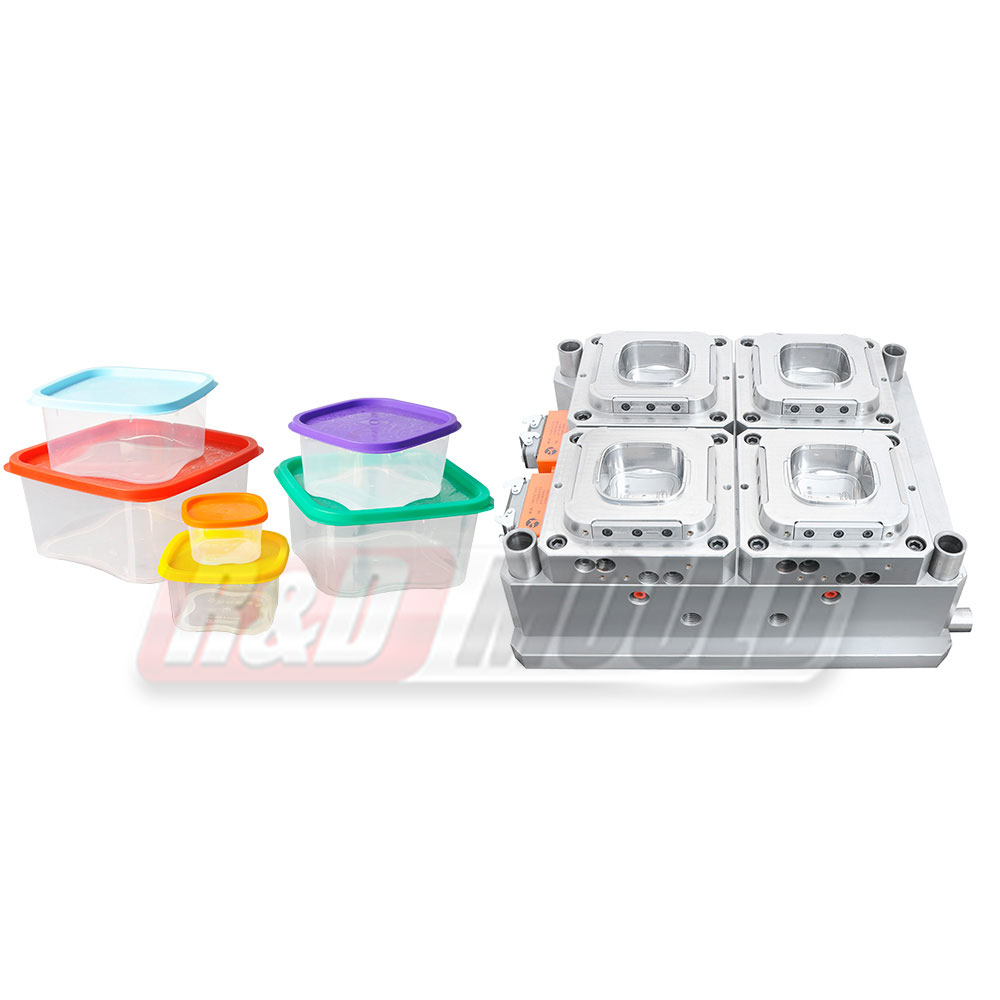
Good corrosion resistance and oil resistance of the final container depend not only on the raw material but also on the surface finish quality inside the mould cavity.
Cavity Configuration and Its Impact on Output
Food container moulds often come in multiple cavity configurations. Depending on container size and production planning, 1 to 8 cavity moulds are commonly used. Increasing cavity count improves output per cycle but also raises requirements for balance and cooling consistency.
A Food Container Mould with poorly balanced cavities may produce containers with visible differences in weight or appearance. This is especially noticeable in transparent or light-colored containers. Careful runner layout and equal flow length help reduce such variation.
An experienced Food Container Mould Manufacturer evaluates cavity layout together with machine capability to avoid unnecessary adjustments after mould delivery.
Customisation in Food Container Mould Projects
Food containers vary in size, lid structure, sealing method, and stacking design. Standard moulds seldom meet all application needs. Custom Food Container Mould development allows adjustments in depth, corner radius, logo placement, and lid fit.
For example, LOCK& LOCK style containers require accurate sealing surfaces. Any deviation in mould accuracy may affect user experience. Preserving boxes and lunch boxes may focus more on stacking stability and internal volume.
R&D Mould, as a professional plastic Food Container Mould manufacturer in China, has developed many types and sizes of food container storage moulds. This background supports flexible customisation while maintaining a stable mould structure.
Design choices around cavity layout, cooling structure, hot runner use, and material selection all influence how smoothly the mould performs during daily operation. With experience across different container types and sizes, a capable Food Container Mould Manufacturer can translate functional requirements into practical mould solutions. By aligning mould design with real manufacturing conditions, food container projects can move forward with clearer output expectations and fewer adjustments over time.