

 English
 عربى
عربى Español
 Français
Bucket products, such as paint pails, are used in packaging environments where volume and consistency are crucial every day. A well-planned bucket mold supports stable injection, balanced wall thickness, and clean appearance across each cycle. For container moulds ranging from 0.5L to 22L, design quality has a direct connection to how smoothly production runs.
Professional design starts before any steel is cut. Product size, shape, and wall thickness are reviewed to match cavity layout and runner structure. This step helps avoid uneven filling and visible surface issues. Experienced bucket mold Manufacturers place strong attention on mould structure because paint buckets are often stacked, transported, and filled under continuous conditions.
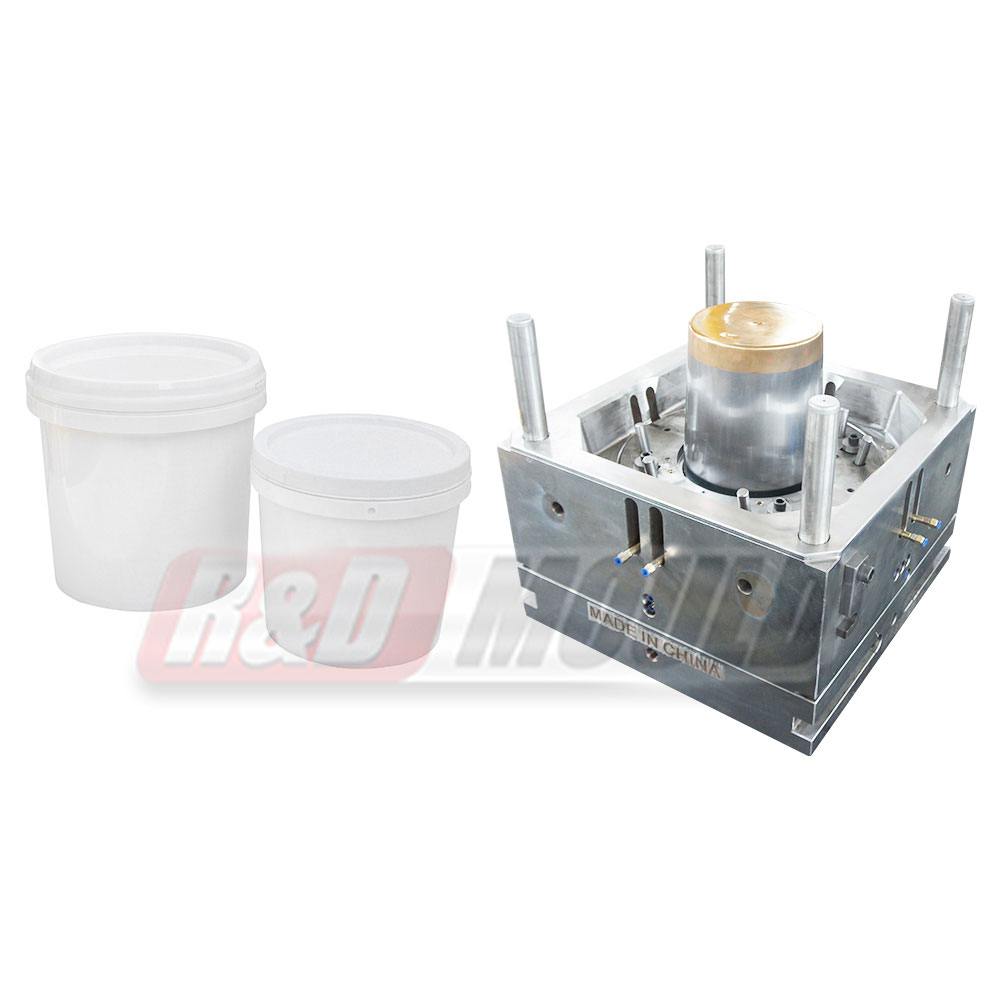
Cooling system planning is part of early design rather than an afterthought. Poor cooling layout can slow production rhythm and affect the bucket surface near sensitive areas. A clear design approach keeps later adjustments limited and keeps output predictable.
How Cooling System Design Affects Bucket Mold Performance
Cooling is one of the core technical points in bucket mold development. For paint pail moulds, cooling channels are designed in the core, cavity, slider, and stripper. In the core area, channels are usually placed around 15 mm below the molding surface, with diameters larger than 12 mm. This layout allows water to circulate smoothly and remove heat evenly.
The cavity side also requires special attention. Areas close to the hot runner tip are sensitive to temperature changes. If cooling is not balanced in this zone, the cycle rhythm can slow, and surface appearance may vary. Bucket mold Manufacturers often refine this area carefully to keep injection stable across long production periods.
For thin-wall container moulds and IML applications, the cooling balance becomes even more noticeable. Uniform cooling supports a consistent shape and helps buckets release smoothly during ejection.
Steel Selection and Precision Machining in Bucket Mold
Steel choice influences how a bucket mold performs over time. For mould life around one million shots, 2738 steel with hardness in the HRC35–38 range is commonly selected for cavity and core. For higher output demands above three million shots, 2344 steel with higher hardness is often used.
Some production lines focus on faster injection cycles. In these cases, BeCu inserts may be applied at the core top, cavity bottom, or slider areas to improve heat transfer. This approach supports shorter cooling periods without changing the overall mould structure.
.jpg)
Precision machining also plays a key role. Core eccentricity can cause uneven wall thickness and off-center buckets, a common issue in paint pail moulds. Careful tooling processes and accurate alignment help keep material flow even and reduce stress on mould components during repeated cycles.
How Bucket Mold Manufacturers Support Stable Long-Term Use
Manufacturing quality depends on more than design drawings. Deep-hole drilling is used for creating cooling channels, while CNC machining handles tooling surfaces to maintain dimensions within tolerance. These processes support smooth mould opening and consistent parting lines during daily operation.
Testing reflects real production needs rather than short trials. Continuous running allows observation of cooling balance, ejection behavior, and alignment stability. Adjustments made at this stage help the bucket mold adapt better to ongoing production.
Bucket mold Manufacturers with experience in paint pail moulds understand how small structural details affect output over time. When cooling layout, steel selection, and machining accuracy work together, the mould becomes a stable part of container manufacturing rather than a source of frequent corrections.
A bucket mold built with practical design logic supports consistent appearance, even wall thickness, and steady production rhythm across different container sizes.